
Baton Rouge, LA · Garage Door Service
What We Actually Check During a Baton Rouge Service Call
Baton Rouge homes built mostly from 1962 to 2013 mean a service call checks spring size, track wear, and opener age for this heat-moderate climate area.
- Repairs & new doors
- Springs & openers
- Serving 6 nearby communities
How Local Conditions Play In
Baton Rouge sits in a heat-moderate climate band, not a freeze-thaw one, and that changes what wears out first on a garage door here. There's no ice splitting a seam, no snow load bending a track. Instead you get sustained heat working on rubber weatherstrip until it cracks and shrinks away from the frame, and on nylon rollers until they go brittle and start chattering in the track. Lubricant that would hold up fine somewhere colder breaks down faster here and leaves springs and hinges dry.
Most of the housing stock in this service area went up between 1962 and 2013, with the heaviest concentration from the 1980s and '90s - a median build year of 1989. That means a lot of the doors we see are steel sectional units on torsion hardware sized for builders working thirty to forty years ago, paired with openers that have been swapped once or twice since. A service call isn't a generic once-over. It's checking a specific combination: original torsion spring wind against a newer opener motor, original track against a replacement panel, original hinges against whatever hardware got added when something broke in year fifteen.
The Situation
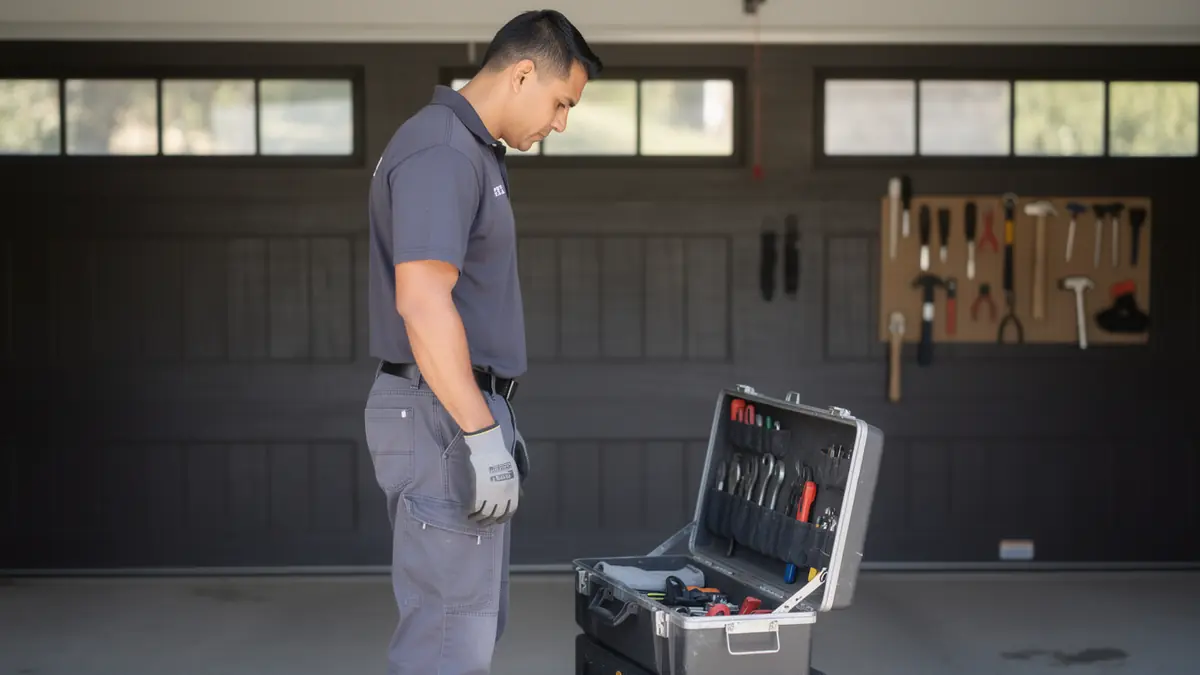
When we come out for a service call, we're looking at the whole system, not just the symptom you called about. That means spring tension and balance (does the door hold position at half-open, or drift), cable condition at the drum and the bottom bracket, track alignment top to bottom, roller condition, and the opener itself - motor sound, limit settings, safety sensor alignment, and reverse function.
Across this area, the spread of door ages means two houses a few miles apart can need completely different parts. A call in Mid City South or Lobdell/Woodale, both close in, might turn up original 1980s hardware that's simply tired. A call out toward Oak Hills Place or Village St. George, six or seven miles out, might turn up a door that's already been replaced once and just needs the opener sensors re-aligned. We don't assume based on the neighborhood - we check the door in front of us, because the build year on the house doesn't always match the build year on the door.
Leaving It Alone
Here's the honest part: not every noise means call today. A door that's a little noisy but still opens smooth and holds its position can usually wait a couple weeks without getting worse. What can't wait is a door that's started to sag on one side, a spring with a visible gap in the coil, or an opener that reverses before it touches the floor - those get worse fast, not slow.
One limitation worth saying plainly: we don't carry every torsion spring width and wire gauge on the truck. This area has forty-plus years of different builders and at least a couple of rounds of door replacements layered on top of each other, so spring sizing isn't standardized house to house. If your spring doesn't match what's on the truck, that's a return trip, not a same-visit fix. It's not a dodge - it's just what happens when the housing stock spans five decades and multiple builders across more than twenty named areas.
When to Call Someone
Call now, not later, for a few specific signs: a loud bang followed by the door refusing to lift (usually a snapped torsion spring), a door that's visibly crooked in the opening, cables that look frayed or kinked at the drum, or an opener that struggles and then reverses mid-close. Any of those can turn into a trapped car or a dropped door, and none of them get better on their own.
For softer symptoms - a squeak, a slightly slow close, a roller that rattles - you've got room to schedule rather than scramble. At the median household income for this area, $85,189, most owners are better off catching a worn spring or roller before it takes the cable or the opener motor down with it. Fixing one part early is a smaller bill than replacing three parts after a failure.
Frequently asked questions
How often should my garage door get a service call in Baton Rouge?
There's no fixed federal schedule, but given the heat-moderate climate here, once a year is reasonable for checking weatherstrip, rollers, and lubrication before summer heat dries everything out. Houses with original 1980s-90s hardware benefit from a second look at the five-year mark, since that's often when torsion springs and nylon rollers start showing their age.
Will a service call tell me if I need a new opener or just a repair?
Yes - part of the call is listening to the motor, checking the limit and force settings, and testing the safety reverse. If the motor's straining but the gears are fine, that's usually a repair. If the circuit board's failing or the motor's worn past adjustment, we'll tell you that's a replacement conversation, not talk you into one.
My house is older than most in the area - does that change what you check?
It can. Housing here runs from 1962 up through 2013, so an older house might still have its original hardware where a newer one has already been through a door swap. We check the actual spring size, track width, and opener model on your door rather than assuming based on when the house was built.
Related garage door services in Baton Rouge
More garage door guides
Book garage door service in Baton Rouge
Call now or request a quote - tell us what the door is doing and where you are.